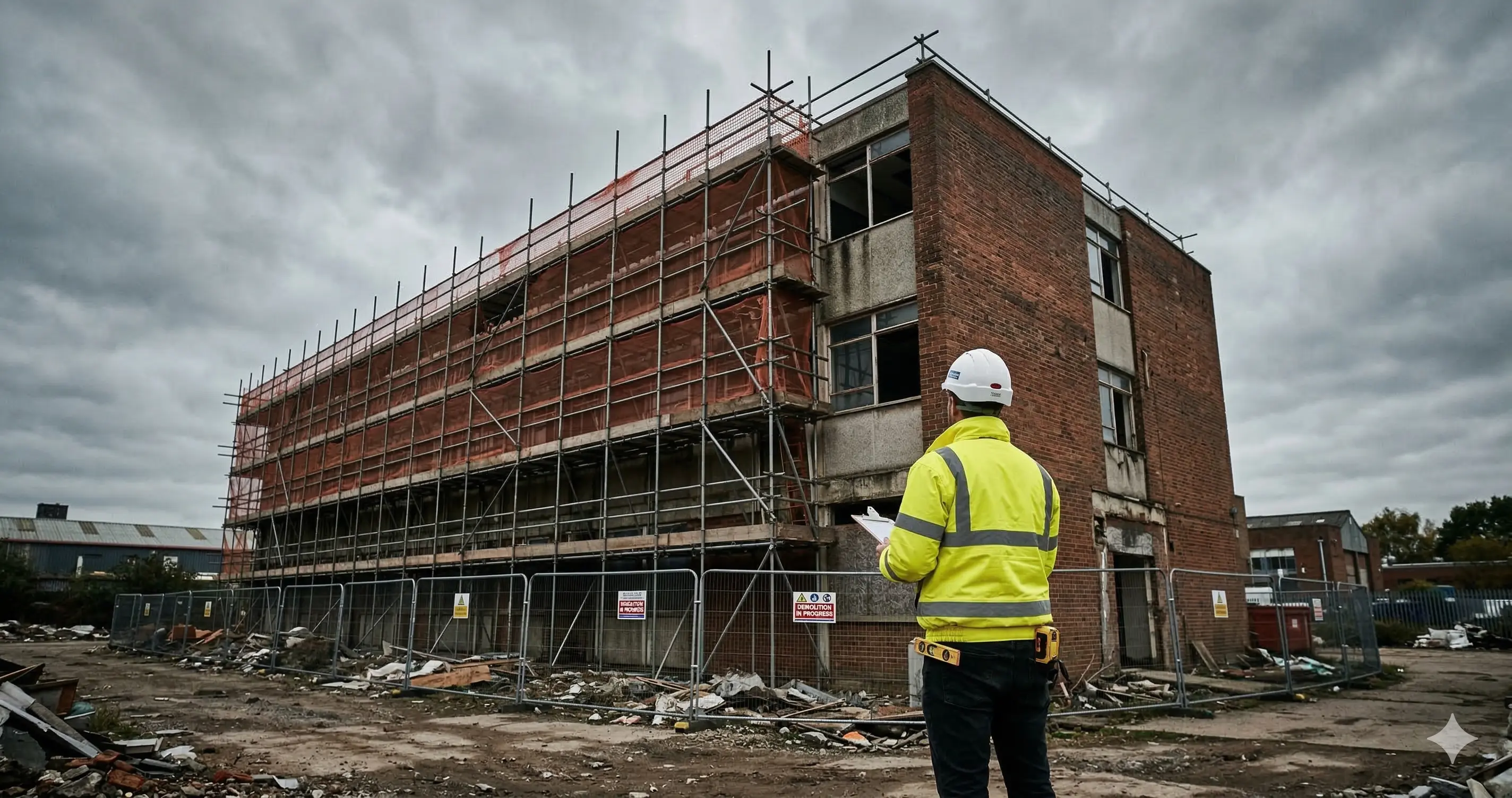
A refurbishment and demolition (R&D) asbestos survey is a legal requirement before any building in the UK is demolished or substantially refurbished. Commonly called a demolition asbestos survey or pre-demolition survey when the whole building is coming down, it is the most thorough type of asbestos survey — designed to locate every asbestos-containing material in a structure before work begins. This guide covers the legal requirements, what the survey involves, ASB5 notification, who is responsible, and what it costs.
Key Facts
- ✓ Legally required before demolition of any building under CAR 2012 and HSG264
- ✓ Must be carried out by a UKAS-accredited inspection body (ISO 17020)
- ✓ Covers the entire structure — including hidden voids, structural elements, and underground services
- ✓ Destructive in nature — walls, floors, and ceilings may be opened up to take samples
- ✓ All asbestos found must be removed by a licensed contractor before demolition begins
- ✓ Licensed asbestos removal requires 14 days advance notice to the HSE
What Is a Demolition Asbestos Survey?
A demolition asbestos survey is a type of refurbishment and demolition (R&D) survey carried out before an entire building — or a substantial structural section of it — is demolished. Unlike a management survey, which identifies ACMs that may be disturbed during normal building use, a demolition survey must identify every ACM in the structure with no exceptions.
The survey is intrusive and destructive by design. Surveyors will open up wall cavities, lift floor tiles, remove ceiling panels, access roof voids and underground service runs, and sample structural materials. The goal is to produce a complete asbestos inventory so that nothing is missed before demolition begins.
The methodology for demolition surveys is set out in HSG264: Asbestos — The Survey Guide, published by the Health and Safety Executive. This is the definitive UK guidance document for asbestos surveying and is followed by all UKAS-accredited inspection bodies.
Refurbishment and Demolition Survey vs Demolition Survey: Is There a Difference?
The terms cause a lot of confusion, but they describe the same category of survey. HSG264 defines only two survey types: the management survey and the refurbishment and demolition survey (often shortened to R&D survey). What people call a “demolition asbestos survey”, a “pre-demolition asbestos survey”, or a “pre-demolition survey” is a refurbishment and demolition survey scoped to cover the entire structure, because the whole building is coming down.
- Refurbishment survey: an R&D survey limited to the areas affected by planned refurbishment, renovation, or fit-out works
- Demolition survey: an R&D survey of the complete building — every room, void, riser, and structural element — carried out before demolition
Whichever name appears on the quote, check the scope: for demolition, the survey must state that it covers the whole structure to the standard required by HSG264. A refurbishment-scoped R&D survey of one floor does not authorise demolition of the building.
Legal Requirements
The legal framework for demolition asbestos surveys is established by several overlapping regulations:
| Legislation | Requirement |
|---|---|
| CAR 2012, Regulation 5 | Before any demolition or refurbishment work, the duty holder must have a written assessment of the likelihood of ACMs being present. For demolition, this means a full R&D survey. |
| CAR 2012, Regulation 7 | Before any work that is liable to disturb asbestos, a written plan of work must be prepared — which requires knowledge from a prior survey. |
| CAR 2012, Regulations 8–20 | Set out the specific requirements for licensed and notifiable asbestos work, including removal before demolition. |
| CDM Regulations 2015, Regulation 4 | Clients must ensure pre-construction information — including asbestos surveys — is gathered and made available to the principal designer and principal contractor. |
| HSG264 | HSE guidance document setting out the methodology for R&D surveys, which all UKAS-accredited surveyors must follow. |
There is no exemption for newer buildings. While buildings constructed after 2000 are unlikely to contain asbestos (it was banned in the UK from November 1999), a survey is still required to confirm this. Buildings erected between 1985 and 1999 are lower risk for some ACM types but may still contain chrysotile (white asbestos) in floor tiles, roof sheets, and textured coatings.
Who Is Responsible?
Under the CDM Regulations 2015, responsibility for commissioning a demolition asbestos survey sits primarily with the client — the person or organisation paying for the demolition works. In practice:
- The client must commission the survey before appointing a principal contractor
- The principal designer must incorporate asbestos information into the pre-construction health and safety file
- The principal contractor must ensure that all asbestos is removed before demolition begins and must not proceed if survey information is incomplete
- The demolition contractor must not start work without receiving a copy of the asbestos survey report
Failure to commission a survey — or proceeding with demolition before all ACMs have been removed — exposes the client and contractor to HSE prosecution, unlimited fines, and potential imprisonment for gross negligence.
Get Quotes From UKAS-Accredited Surveyors
Tell us about your property and we'll match you with up to 3 accredited surveyors in your area. Free, no obligation.
Free service · No obligation · UKAS-verified surveyors only
What Does a Demolition Survey Involve?
- Pre-survey review: The UKAS-accredited surveyor reviews available building plans, previous asbestos records, and any known history of the structure to plan sampling locations and identify high-risk areas
- Full-access intrusive inspection: All areas of the building are accessed — including roof spaces, wall cavities, floor voids, service risers, plant rooms, lift shafts, and underground ducts. Ceilings are opened, floor tiles lifted, and structural materials sampled. No area is excluded
- Bulk sampling: Physical samples are taken from all suspect materials and sent to a UKAS-accredited laboratory for analysis by polarised light microscopy (PLM). A minimum number of samples per homogeneous area is specified in HSG264
- Report production: A comprehensive written report is produced detailing every ACM found — its type, location, extent, condition, and recommended action (removal or encapsulation). A drawing or floor plan marking ACM locations is included
- Asbestos removal planning: The report is handed to the client and principal contractor to commission a licensed asbestos removal contractor before demolition works proceed
How Long Does a Demolition Survey Take?
Survey duration depends on the size and complexity of the building:
| Building Type | On-site Duration | Report Delivery |
|---|---|---|
| Small domestic (1–2 bed) | Half day – 1 day | 5–10 working days |
| Larger domestic (3–4 bed) | 1–2 days | 5–10 working days |
| Small commercial (up to 500m²) | 1–3 days | 5–10 working days |
| Large commercial / industrial | Several days – 2 weeks | 10–15 working days |
Express laboratory turnaround (24–48 hours) is available from most UKAS-accredited labs at additional cost if there is time pressure on the project programme.
How Much Does a Demolition Survey Cost?
Demolition surveys are significantly more expensive than management surveys because of the greater access, time on site, and number of samples required. Typical 2026 costs:
| Property Type | Typical Cost |
|---|---|
| Small residential (1–2 bed) | £500–£800 |
| Larger domestic (3–4 bed) | £700–£1,200 |
| Small commercial (up to 500m²) | £800–£2,000 |
| Medium commercial (500–2,000m²) | £2,000–£5,000 |
| Large industrial / institutional | £5,000–£15,000+ |
These figures cover the survey and report only — they do not include asbestos removal, which is priced separately by the removal contractor based on the survey findings. The survey cost is typically a small fraction of the total demolition project budget and far less than the cost of delays caused by unexpected asbestos discovered mid-demolition.
Always obtain at least two or three quotes from UKAS-accredited firms. Price should not be the only factor — check that the firm holds current UKAS accreditation to ISO 17020 and has experience with demolition surveys on similar building types.
What Happens After the Survey?
Once the survey report has been issued, the following steps must occur before demolition can legally proceed:
- Commission asbestos removal: A licensed asbestos removal contractor (LAC) must be appointed to remove all ACMs identified in the survey. For licensed work, the contractor must notify the HSE at least 14 days before work begins using an ASB5 notification form
- Asbestos removal: The LAC removes all ACMs in accordance with the plan of work. Licensed removal work must be carried out in a sealed enclosure with air monitoring throughout
- Air clearance testing: Following removal, a 4-stage clearance procedure including air testing must be completed by an independent UKAS-accredited body before the enclosure is dismantled. The air testing must demonstrate fibre concentrations below 0.01 fibres/ml
- Certificate of reoccupation: The surveyor issues a clearance certificate confirming the area is safe. Only then can demolition works begin
ASB5 Notification: Telling the HSE Before Removal Starts
If the survey identifies asbestos that requires licensed removal — such as pipe lagging, sprayed coatings, or asbestos insulating board — the removal contractor must notify the HSE using the ASB5 form (“Notification of asbestos work”) at least 14 calendar days before work begins. See our full ASB5 notification guide for who submits it, how the online form works, and how it differs from NNLW.
- Who submits it: the licensed asbestos removal contractor (LAC), not the building owner or client — but the 14-day clock directly affects your project programme
- How it's submitted: online via the HSE's ASB5 e-form, which asks for the site address, type and quantity of ACMs, the plan of work, and enclosure details
- Can the 14 days be waived? Only in genuine emergencies (e.g. severely damaged asbestos creating immediate risk) can the HSE agree a shorter period — routine project deadlines do not qualify
- Non-licensed work: lower-risk removal (e.g. asbestos cement sheets in good condition) does not need an ASB5, though notifiable non-licensed work (NNLW) must still be notified to the HSE online before it starts — with no minimum notice period
For demolition projects, the practical consequence is simple: between the survey report, the ASB5 notice period, removal, and the 4-stage clearance, allow a minimum of 4–6 weeks between commissioning the survey and the start of demolition where licensed asbestos is likely to be present.
Common Mistakes to Avoid
- Using a non-UKAS surveyor: Only UKAS-accredited inspection bodies are recognised under CAR 2012. A report from an unaccredited surveyor has no legal standing and will not satisfy enforcement or insurance requirements
- Assuming a newer building is asbestos-free: Even buildings from the 1990s may contain ACMs. A survey is always required — assumptions are not acceptable
- Starting demolition before removal is complete: Demolition contractors must not begin structural works while ACMs remain in the building. Doing so is a criminal offence under CAR 2012
- Failing to share the survey with contractors: The survey report must be passed to all contractors who will work on the site before they start work — this is a legal requirement under CAR 2012
- Not allowing enough time: Factor in survey time, lab analysis, report delivery, HSE notification periods (14 days for licensed work), and removal time when planning your demolition programme